
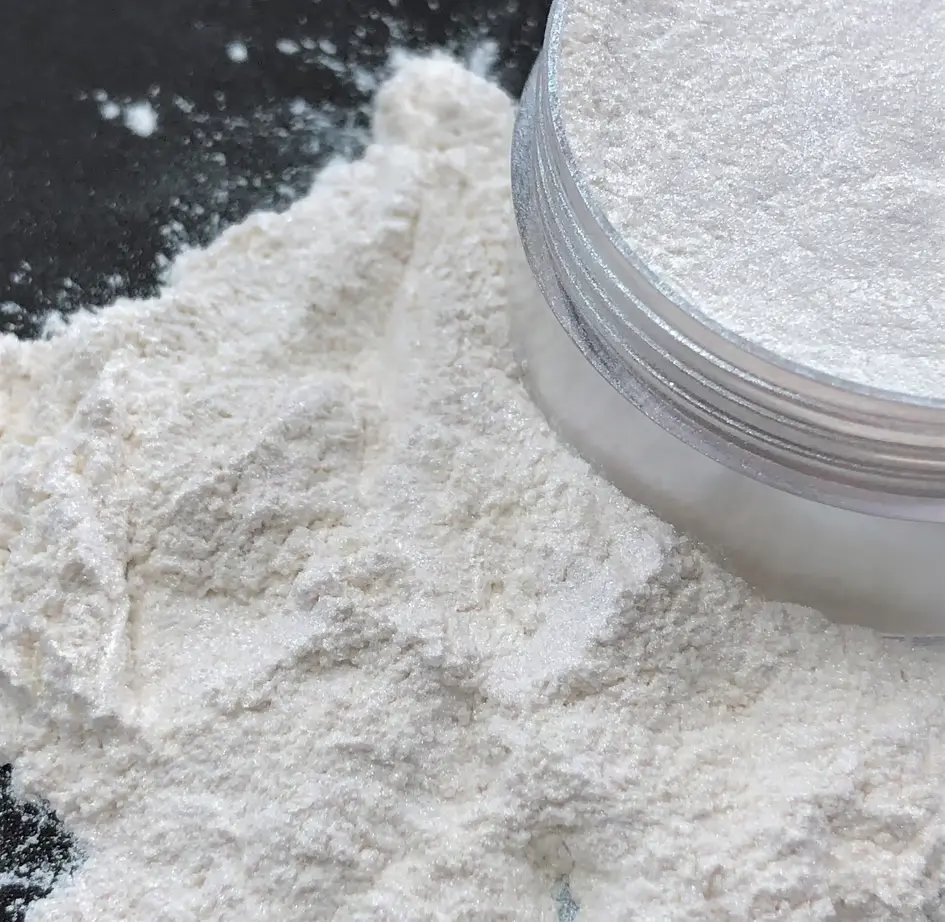
Titanium dioxide does more than make a pearl pigment look white. When TiO₂ is deposited as a controlled thin layer on mica, differences in refractive index split and recombine light. The coating thickness decides whether the pigment appears silver-white or shows an interference colour.
A TiO₂ pearl pigment is not the same as a blend of mica and ordinary white TiO₂. The optical effect depends on a uniform coating, platelet geometry and alignment inside the finished film.
How a TiO₂-coated mica platelet works
Part of the incoming light reflects from the outer TiO₂ surface. Another part passes through the coating and reflects at a deeper interface. When those light paths recombine, selected wavelengths reinforce one another while others weaken. This is thin-film interference, the same basic optical principle behind many pearl and iridescent surfaces.
What TiO₂ contributes
Brightness
The refractive-index contrast creates strong surface reflection and a clean pearl highlight.
Interference colour
Increasing the optical thickness shifts the reinforced wavelengths through gold, red, blue and green.
Formulation flexibility
TiO₂-mica pigments are used in coatings, plastics, inks and suitable cosmetic formulations.
Controlled appearance
Fine grades give smoother satin effects; coarser grades give stronger sparkle and light movement.
Silver pearl and interference pearl are related, but not identical
A relatively thin coating reflects a broad range of visible light and appears silver-white. At selected greater thicknesses, constructive interference strengthens narrower wavelength bands. The pigment may look nearly white over a light background but show a strong complementary colour over black. That is why interference shades must be evaluated over both light and dark panels.
| Variable | What changes in the finish | What to test |
|---|---|---|
| TiO₂ coating thickness | Silver versus interference hue | Face colour and angle-dependent colour |
| Platelet size | Satin versus sparkle | Surface smoothness, coverage and brilliance |
| Pigment loading | Effect strength and hiding | Several loadings in the actual binder |
| Orientation | Brightness and flop | Application method, film thickness and cure |
| Base colour | Contrast and apparent hue | White, grey, black and intended substrate |
What “without TiO₂” really means
A bare mica flake has lustre but does not produce the same high-index thin-film effect. Other effect pigments can use iron oxide, mixed metal oxides, silica, alumina or glass-based architectures. They are not simply inferior TiO₂-free versions; they are different optical systems selected for different colour and functional targets.
Formulation guidance
- Pre-wet gently. Use a compatible liquid from the formulation and avoid dry clumps.
- Limit destructive shear. Add pearl pigment after aggressive grinding where the process allows.
- Protect orientation. Excess viscosity, poor levelling or very rough substrates can reduce brilliance.
- Compare at equal conditions. Use the same loading, film build, base colour and application method.
- Approve the exact grade. Confirm current documents and application-specific requirements.
References and further reading
- Okubo, Basic Technology and Recent Trends of Pearlescent Pigment
- Optical behaviour and processing of titania-coated mica pigments
Frequently asked questions
Why is titanium dioxide used in pearl pigments?
Titanium dioxide has a high refractive index. A controlled TiO2 layer on a transparent platelet creates strong reflections and thin-film interference, producing silver, pearl and interference effects.
Does more titanium dioxide always create more opacity?
No. In a pearl pigment, TiO2 is a thin optical coating rather than ordinary white pigment dispersed through the formula. Layer thickness changes interference colour, while platelet size, loading, orientation and the base colour affect hiding and brightness.
Can TiO2 pearl pigment be added with high shear?
Prolonged high shear can break platelets and reduce sparkle. Wet the pigment gently, add it late where practical, and validate the process at production scale.
Formulation support
Choose the effect in the finished formulation, not from a powder photograph
Tell EMS the application, resin or binder, processing conditions, target particle size and reference finish. We can recommend a starting grade and arrange a sample for a controlled trial.