
Magnetic pearl pigments create apparent depth by controlling platelet orientation before a coating, ink, resin or gel cures. The pigment supplies the colour and directional reflection; the magnetic field supplies the pattern.
Disperse the pigment → apply a mobile wet film → position the magnetic field → allow the platelets to orient → cure or dry while the pattern is held.
How the 3D illusion is created
Ordinary pearl-pigment platelets tend to lie broadly parallel to the surface. They reflect light in a relatively uniform band. A magnetically responsive layer allows selected platelets to rotate or migrate along field lines while the film is still fluid. Adjacent regions then reflect light at different angles. The eye interprets the moving highlight and dark-to-bright gradient as a ridge, wave, tunnel or cat-eye shape.
The five variables that control the result
Magnet geometry
A bar, ring, patterned tool or moving field creates a different orientation map.
Distance
Field strength drops with distance, so tool-to-film spacing must be repeatable.
Wet-film mobility
If viscosity is too high, platelets move slowly; if too low, the pattern may relax or sag.
Open time
The field needs enough time to orient particles, followed by a cure fast enough to lock them.
Film construction
Base colour, thickness, pigment loading and clearcoat alter contrast and depth.
Particle integrity
Excessive shear can damage effect platelets and reduce directional brilliance.
A practical development workflow
- Select one pigment shade. Keep the colour constant while comparing pattern variables.
- Prepare a controlled dispersion. Record binder, loading, viscosity and mixing sequence.
- Apply equal wet films. Use the same substrate, applicator and film build.
- Vary one magnetic parameter at a time. Start with distance, exposure time and tool shape.
- Lock the orientation. Hold the field through the critical drying or curing window.
- Evaluate at multiple angles. Photograph and measure the same panel under repeatable lighting.
Where magnetic effects can be evaluated
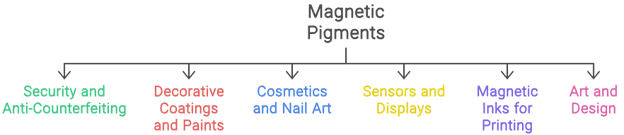
Potential uses include decorative coatings, automotive accents, synthetic leather, inks, luxury packaging, resin components and nail-effect systems. Application suitability is not automatic. The complete system must meet its own adhesion, durability, safety, regulatory and production requirements.
Common reasons a pattern looks weak
- The pigment is not sufficiently dispersed or is damaged by milling.
- The film begins to set before the particles finish moving.
- The magnet is too far away or is removed too early.
- The base colour does not provide enough contrast.
- The pigment loading is too low, or so high that the gradient loses definition.
- The production geometry differs from the successful laboratory trial.
EMS Magnetic Series status
EMS offers Magnetic Series grades for sampling and formulation development. Bulk suitability, lead time and technical documentation should be confirmed for the selected grade. EMS has also filed IP around magnetically responsive pearl-pigment effects; commercial trials should focus on the customer’s actual application and process window.
Reference
Frequently asked questions
What is a magnetic pearl pigment?
It is an effect pigment whose platelets respond to a magnetic field while mobile in a wet coating, ink, resin or gel. Their controlled orientation changes directional reflection and creates apparent depth.
Does the magnet permanently magnetise the finished coating?
The intended visual effect comes from orienting responsive platelets before the film locks. Whether any residual magnetic response remains depends on pigment chemistry and formulation, but the visible pattern is preserved mainly by curing the oriented film.
Why can the same pigment produce different patterns?
Magnet shape, distance, exposure time, viscosity, film thickness, pigment loading and cure timing all change platelet movement and the final reflected-light pattern.
Formulation support
Choose the effect in the finished formulation, not from a powder photograph
Tell EMS the application, resin or binder, processing conditions, target particle size and reference finish. We can recommend a starting grade and arrange a sample for a controlled trial.