
Natural mica and synthetic fluorphlogopite can both be excellent substrates for pearl pigments. The important question is not which material is universally better. It is which substrate, particle-size distribution and metal-oxide coating produce the required appearance and meet the application specification.
Choose natural mica when you need a proven, widely available mineral substrate and the grade meets your colour, purity and traceability requirements. Choose synthetic mica when a cleaner base colour, high transparency or tighter substrate control materially improves the finish. Always compare the coated pigments in the final formulation.
What is the substrate doing inside a pearl pigment?
A pearl pigment is a layered optical particle. A flat mica platelet provides the shape; a controlled coating of titanium dioxide, iron oxide or another metal oxide creates reflection, absorption and thin-film interference. The quality of both parts matters. A smooth platelet helps the coating form evenly, while particle size and orientation influence whether the finish looks satin, silky or sparkling.
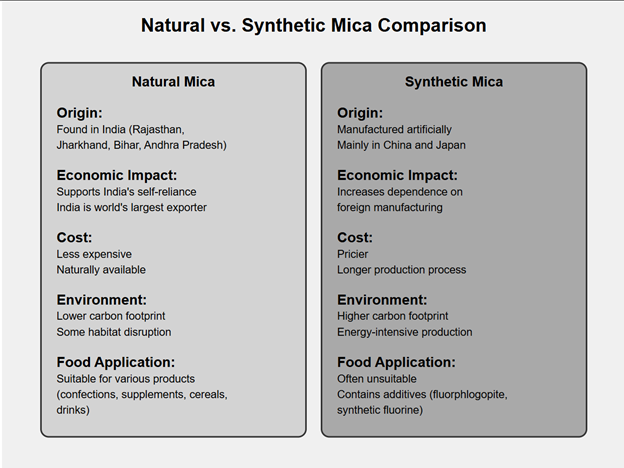
Natural mica and synthetic mica compared
| Selection point | Natural mica | Synthetic fluorphlogopite |
|---|---|---|
| Origin | Mined, beneficiated and classified mineral | Manufactured from controlled mineral inputs at high temperature |
| Base colour | Varies by deposit and purification | Often cleaner and more transparent because iron and other impurities can be tightly controlled |
| Surface and thickness | Good grades are consistent, but natural variation must be managed | Can provide a smooth surface and narrow substrate specification |
| Optical effect | Well suited to silver, gold, interference and metallic effects | Useful where clarity, chroma and a very clean background are priorities |
| Supply and cost | Usually the more established and cost-effective route | Generally carries a higher manufacturing and sourcing cost |
| Sustainability question | Traceability, mine practices and processing efficiency matter | Energy demand and raw-material inputs matter |
Four decisions that matter more than the label
1. Match the finish
For a soft satin coating, a fine natural-mica pigment may be exactly right. For a high-chroma cosmetic or transparent resin, a synthetic-mica grade may give a cleaner result. Neither conclusion can be made from substrate name alone.
2. Compare particle-size distribution
A nominal range does not tell the whole story. Ask for current particle-size information and compare sparkle, coverage and surface smoothness at equal loading. Coarser platelets usually produce more visible sparkle; finer platelets usually create a smoother sheen.
3. Check the complete coated pigment
The metal-oxide layer controls much of the colour. Coating thickness, uniformity and crystal form can outweigh modest differences in the underlying mica. Compare the exact commercial grades, not uncoated mica samples.
4. Qualify for the intended market
Natural does not automatically mean food grade, and synthetic does not automatically mean unsuitable. Food, cosmetic, packaging and industrial uses have different composition and purity requirements. Obtain the current TDS, SDS, CoA and any application-specific declarations before approval.
What EMS uses
EMS primarily develops pearl pigments on responsibly sourced natural Indian mica, using controlled classification and metal-oxide deposition. This route supports local value addition and allows EMS to offer silver, interference, gold, coloured and metallic series for B2B evaluation. Where a customer specification calls for another substrate, the discussion should begin with the required optical and regulatory outcome.
Practical qualification checklist
- Define face colour, flop, sparkle and hiding target.
- Compare drawdowns at equal pigment loading and film thickness.
- Check dispersion method and platelet damage after processing.
- Review batch consistency, traceability and impurity limits.
- Confirm regulatory suitability for the exact application and market.
References and further reading
- Okubo, Basic Technology and Recent Trends of Pearlescent Pigment
- Optical and material properties of synthetic fluorophlogopite
- US FDA: regulatory status of mica-based pearlescent pigments
Frequently asked questions
Is synthetic mica always better than natural mica?
No. Synthetic fluorphlogopite can offer high transparency, smoothness and controlled purity, while well-processed natural mica can provide strong performance, broad availability and a different cost profile. The correct choice depends on the target finish and specification.
Can natural and synthetic mica be substituted one for one?
Not automatically. Platelet size, thickness, surface quality, metal-oxide coating and impurity profile can change colour, gloss, coverage, skin feel and processing behaviour. Compare approved grades in the finished formulation.
Is either mica type automatically food or cosmetic grade?
No. Suitability depends on the complete pigment composition, purity, manufacturing controls and the rules for the intended use and market. Request current supplier documents and verify the applicable regulation before approval.
Formulation support
Choose the effect in the finished formulation, not from a powder photograph
Tell EMS the application, resin or binder, processing conditions, target particle size and reference finish. We can recommend a starting grade and arrange a sample for a controlled trial.