
Ferric oxide-coated mica combines the warm absorption colour of Fe₂O₃ with the directional reflection of a platelet. The result is not simply “brown pigment with sparkle.” Properly designed grades can produce gold, copper, bronze, russet and deep red effects that change in brightness as the viewing angle moves.
Ferric oxide does not increase whiteness. It is a coloured, light-absorbing oxide. Its value in pearl pigments is warm colour, depth and the way absorption works together with reflection and interference.
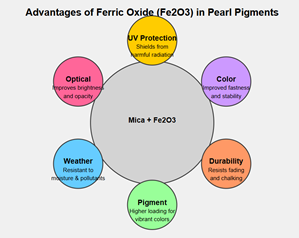
How Fe₂O₃ changes the optical effect
Ferric oxide absorbs portions of visible light and reflects warm red-to-gold wavelengths. On a flat mica substrate, the coated particle also reflects directionally. The combination produces a richer face colour and a visible change between bright reflection and darker off-angle colour. Coating thickness, platelet size and any additional TiO₂ layer determine the final shade.
Single-layer and multilayer effects
An Fe₂O₃-coated mica can deliver a straightforward bronze, copper or red-brown pearl. Multilayer structures combine absorbing and non-absorbing oxides. Research on mica/Fe₂O₃/TiO₂ pigments shows that placing Fe₂O₃ below TiO₂ can increase colour saturation compared with reversing the layer order. The optical stack—not just the ingredient list—matters.
| Design variable | Likely visual change | Qualification check |
|---|---|---|
| Fe₂O₃ coating amount | Moves colour from lighter gold/bronze toward deeper copper and red-brown | Face colour, undertone and hiding |
| Platelet size | Fine satin versus coarse sparkle | Surface smoothness and light movement |
| Additional TiO₂ layer | Can modify brightness, saturation and interference | Layer-specific drawdown, not composition alone |
| Base colour | Changes contrast and apparent depth | Test over intended substrate and primer |
| Orientation | Controls directional brightness and flop | Application method, viscosity and cure |
Where iron oxide pearl pigments fit
- Coatings: bronze, copper and warm metallic finishes for decorative and industrial surfaces.
- Plastics and masterbatch: moulded colour with directional lustre, subject to processing validation.
- Printing and packaging: premium warm metallic effects where flake orientation is controlled.
- Suitable cosmetics: eye, nail and colour-cosmetic effects using application-approved grades.
- Leather and textiles: warm metallic topcoats after binder, rub and flex testing.
Performance claims need application data
Iron oxides are known for good inherent colour stability, but a pearl pigment’s real performance depends on the whole construction. Do not assume that every Fe₂O₃-coated mica is a corrosion inhibitor, UV stabiliser or high-temperature grade. Request data for the exact pigment and test it in the actual binder, at the intended loading, film thickness and processing temperature.
Formulation checklist
- Choose the target between gold, bronze, copper and red-brown.
- Compare fine and coarse grades for smoothness versus sparkle.
- Add after aggressive milling where possible.
- Evaluate over the actual base colour at equal film build.
- Check viscosity, settling, orientation, adhesion and required durability.
- Approve against the latest TDS, SDS, CoA and regulatory documents.
References and further reading
- Preparation of interference colours using mica/Fe₂O₃/TiO₂ layers
- Research on surface-treated ferric mica in coatings
Frequently asked questions
What does ferric oxide do in a pearl pigment?
Ferric oxide absorbs selected wavelengths and has a high refractive index. When deposited on a platelet, it creates warm gold, copper, bronze and red-brown effects with directional lustre.
Does ferric oxide make a pearl pigment whiter?
No. Ferric oxide is an absorbing coloured oxide. It generally adds warm colour and depth rather than whiteness. Titanium dioxide is the more common coating for clean silver-white pearl effects.
Are iron oxide pearl pigments automatically heat and weather resistant?
Iron oxides are generally stable pigments, but finished performance depends on the exact grade, surface treatment, binder, substrate, processing temperature and exposure conditions. Validate the complete formulation.
Formulation support
Choose the effect in the finished formulation, not from a powder photograph
Tell EMS the application, resin or binder, processing conditions, target particle size and reference finish. We can recommend a starting grade and arrange a sample for a controlled trial.