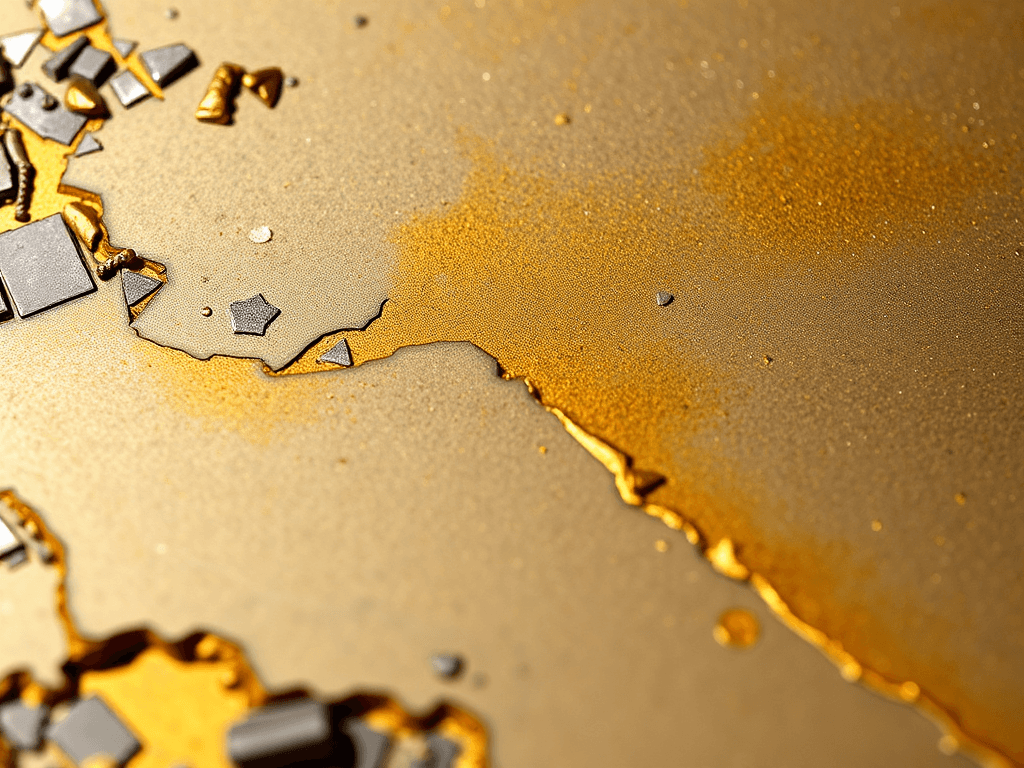
Coating a flat mica platelet with a metal oxide turns a mineral flake into a designed optical material. The oxide determines how much light is reflected or absorbed; its thickness controls interference; and the quality of deposition determines whether the effect is clean and repeatable.
Mica supplies the platform. The metal-oxide architecture supplies most of the visible effect. Particle size and orientation then decide how that effect appears in paint, plastic, ink or a suitable cosmetic system.
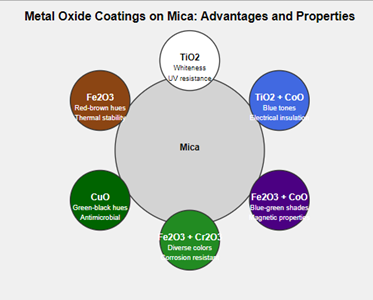
Common coating families
| Coating architecture | Typical visual role | Important qualification point |
|---|---|---|
| TiO₂ on mica | Silver-white lustre and interference colours | Coating thickness, crystal form, brightness and weathering grade |
| Fe₂O₃ on mica | Warm gold, copper, bronze and red-brown absorption tones | Undertone, hiding, heat exposure and binder compatibility |
| TiO₂ + Fe₂O₃ multilayer | Higher colour depth or saturation from interference plus absorption | Layer order and thickness; the two are not interchangeable |
| Magnetically responsive oxide layer | Field-directed patterns and apparent 3D depth | Wet-film mobility, magnet geometry and cure timing |
| Protective surface treatment | Application-specific durability or compatibility | Confirm the actual treatment and supporting test data |
Why coating uniformity matters
Interference colour is highly sensitive to optical thickness. If deposition is patchy or particle-to-particle variation is wide, the reflected wavelengths spread out and the colour loses purity. Manufacturers therefore control pH, temperature, precursor addition, agitation, washing and heat treatment during production. The commercial buyer sees the outcome as cleaner colour, repeatable drawdowns and more predictable batch-to-batch behaviour.
Layer order can change the result
In a multilayer pigment, Fe₂O₃ below TiO₂ does not behave the same way as TiO₂ below Fe₂O₃. Research on mica/Fe₂O₃/TiO₂ structures shows that layer order and thickness change colour saturation and the angle-dependent “flip-flop” effect. This is why a product description such as “mica, titanium dioxide and iron oxide” is not enough to predict appearance.
Do metal oxides automatically add durability?
Some oxide coatings and surface treatments can improve light, heat or weathering performance, but the statement must be tied to the specific grade and test method. A decorative Fe₂O₃ pearl pigment is not automatically an anticorrosive pigment. A TiO₂-coated mica is not automatically a replacement for a dedicated UV stabiliser. Resin, film thickness, dispersion, exposure and pigment surface treatment all affect the result.
How formulators should compare grades
- Start with the optical brief. Define hue, brightness, hiding, sparkle and flop.
- Choose a particle-size family. Fine grades favour smoothness; coarse grades favour visible sparkle.
- Run drawdowns over relevant base colours. Interference pigments need dark and light comparisons.
- Check the process. Excessive milling can fracture platelets; poor flow can disturb orientation.
- Validate durability separately. Use the customer’s actual binder, substrate, cure and exposure test.
References and further reading
- Okubo, Basic Technology and Recent Trends of Pearlescent Pigment
- Preparation of interference colours using mica/Fe₂O₃/TiO₂ layers
Frequently asked questions
Why are metal oxides coated on mica?
The flat mica substrate provides platelet shape, while high-refractive-index or absorbing metal-oxide layers create reflection, interference and colour. Controlled deposition also allows more consistent optical behaviour than uncoated mica.
Which metal oxide creates a bright silver pearl?
Titanium dioxide is the standard starting point for bright silver-white and interference pearl effects. The crystal form, coating thickness and uniformity influence the result.
Do all metal-oxide coatings improve UV or corrosion resistance?
No. Performance depends on oxide chemistry, coating architecture, surface treatment, loading and the complete formulation. Decorative pearl pigments should not be treated as corrosion inhibitors or UV stabilisers without application data.
Formulation support
Choose the effect in the finished formulation, not from a powder photograph
Tell EMS the application, resin or binder, processing conditions, target particle size and reference finish. We can recommend a starting grade and arrange a sample for a controlled trial.